Tokenize This
The arc of financial innovation is long, but it bends towards efficiency.

There’s this thing about crypto conferences that you won’t find anywhere else. Well, two things.
The first is eclecticism. Half the crowd dressed for a costume party, the other half dressed for a funeral. It’s wild. You can show up in the stiffest, darkest suit you own, or show up in a notice-me meme t-shirt. It’s all good, just come as you are.
The second thing is the ideas. Everyone has big ideas. Everyone is contrarian, to the point where contrarianism feels conformist. Everyone has strong opinions about the path of technology, the role of money, the importance of digital privacy, and everything else.
The best conversations I’ve had, and also the craziest, happened at crypto conferences.
I spent the last couple days at the wonderfully named Tokenize This conference in NYC. The dress code appropriately subdued, and the big ideas appropriately unconstrained.
This conference was decidedly nerdy. There was lots of talk about the Genius Act, and the Clarity Act. There was talk about the SEC proposal to suspend parts of Reg NMS*.
*Speaking of strong opinions, I’ve been trying to write a post here, and even a comment letter on this SEC proposal. And I just can’t. I don’t have a hot take, and I don’t have a fully formed opinion on it. Seems dangerous, but also a path to lower barriers to entry and new market structure possibilities… I’ll say it now because who knows when I’ll say it again: I’m just not sure.
There was talk about private asset marks and NAV calculation frequencies.
There was talk about liquidity and market makers and market participants, and product market fit, and when the buyers might finally show up.
There was talk about tokenizing stocks, and bonds, and ETFs, and all sorts of alternative assets and esoteric assets.
There was talk about cross-listing and dual-listing and cross-chain portability and all sorts of ways to solve fragmentation.
There was talk of governance and risk management and compliance and all those nerdy things that are fun to nerd out about.
And there was, of course, talk about real estate tokenization.
Now this is where it gets interesting: there was absolutely no talk about Bitcoin’s crashing price or the MSTR implosion. There was nobody selling FOMO or greed or any double-your-money talk. It was market structure enhancements all the way around. It was pure.
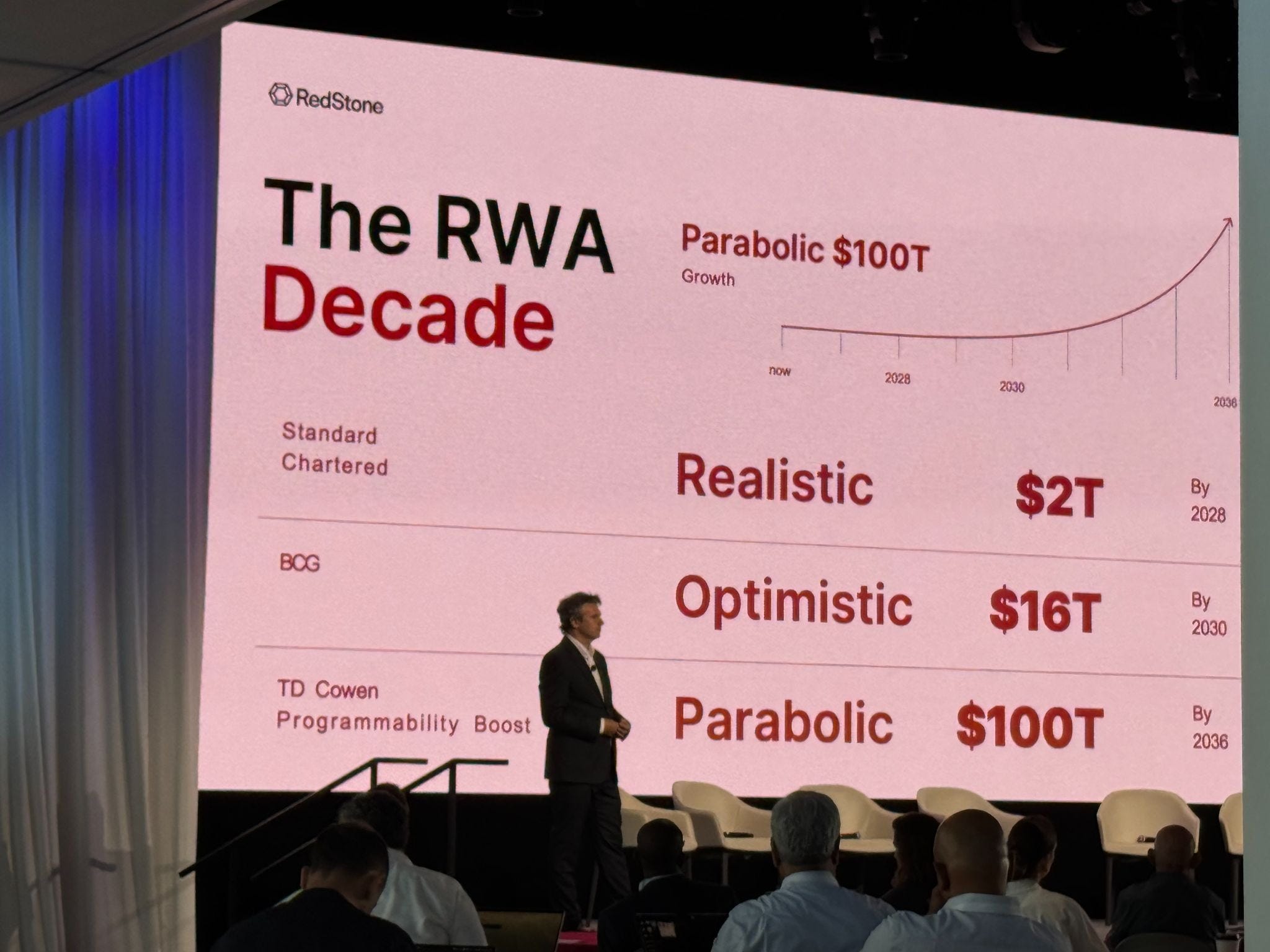
Tokenization is the process of representing ownership or rights to assets on a blockchain, enabling programmable, auditable, and faster transfers. It has nothing to do with Number Go Up.
And it has everything to do with Number Go Up.
Let’s not kid ourselves. Without Bitcoin’s meteoric ride, it is hard to imagine that tokenization would be getting this much attention.
But, regardless of asset performance, on a long enough timeframe, the better wrapper and most efficient technology will win.
Shortly after I started working in ETFs there was a Morningstar article apoplectic that there were over 100 ETFs listed. It was an outrage! There are now almost 5000 ETFs listed in the US.
The arc of financial innovation is long, but it bends towards efficiency.
Let’s go back to real estate. Institutional investors are currently accessing real estate through public REITs that can’t catch a bid, private REITs at fictitious marks and gated liquidity, and direct deals that take months to close. Tokenization is a better way, and for all the right reasons.
Tokenization has attracted problem solvers. Nerdy, in-the-weeds, market structure innovators. It’s a great place to be. And it no longer requires rising crypto asset prices to make the case. The crypto rails have supported volumes that are proof of concept, regardless of what happens next.
The assets that will be tokenized in the coming years are real, tangible, and will be better served by a modernized ecosystem.
For better or for worse, tokenization no longer has anything to do with the price of Bitcoin.