S&P Takes a Stand
Other index companies gave the IPO industry what they want. S&P gave investors what they need.

In honor of the NBA finals let’s start with a quote from former San Antonio Spur Robert Horry:
“Pressure can burst a pipe, or pressure can make a diamond.”
There’s been lots of pressure on the index companies, and until S&P took a stand, they all caved to that pressure. I wrote about this a few days ago, as the Rikishi Moment for the index complex. A moment of humiliation.
And now I need to correct the record, because S&P stood up to that pressure, and, I’d argue, did so on behalf of investors.
What kind of pressure am I talking about? Let’s start here:
According to index provider MSCI’s most recent 10-K filing for 2025, their total revenue was $3.13 Billion, and their revenue from Blackrock’s iShares was $338.5 Million. That’s 10.8% of their total revenue. So who do you think is really calling the shots when it comes down to MSCI index rules?
Man, there’s pressure from everywhere. SpaceX sought rule changes to fast-track entry into major indexes. Anthropic and OpenAI were right behind them, along with their investment bankers and early investors.
The listing exchanges were competing against each other for the primary listing, and NASDAQ was the first to cave, blatantly using their index and YOUR investment dollars as a carrot to lure the IPO.
The pressure on index companies continued from every corner of the market, each with a cleaner story than the last. FTSE Russell said clients asked for a fast-entry review. Its consultation cited asset managers, asset owners, and sell-side firms, with broad support for letting mega-IPOs enter Russell indexes sooner. The respectable argument was benchmark purity: if SpaceX, OpenAI, or Anthropic comes public as one of the largest companies in America, then excluding it for a year makes the benchmark a stale map.
Some passive managers made the tracking-error argument: if active funds can buy the IPO immediately but index funds cannot, passive vehicles get left behind. And, of course, the investment banks want bigger IPOs and more liquidity.

So once Nasdaq and FTSE Russell moved, S&P faced competitive pressure not to look rigid or irrelevant. Hey kids, just be cool, everyone else is doing it!
Instead, S&P Dow Jones rejected proposals to fast-track mega-IPOs into the S&P 500. They kept the 12-month post-IPO and GAAP profitability requirements in tact, without any exception for size.
The key line from S&P: exceptions to financial viability, seasoning, and float requirements should not be granted “solely based on market capitalization.”
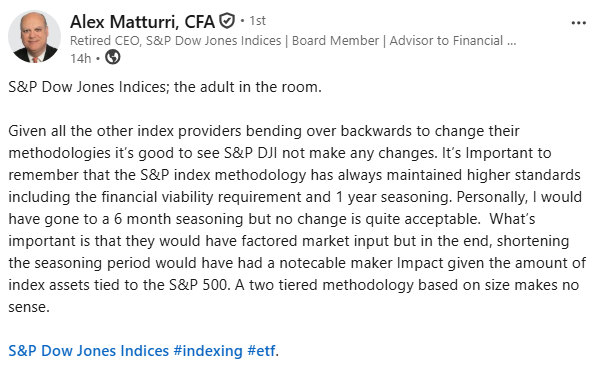
While NASDAQ and FTSE gave insiders what they want, S&P gave investors what they need: an adult in the room, and a consistent and reliable rule set.
In terms of how this will work out for investors, we don’t know. But we do know SpaceX is estimated to IPO at as much as a $2T valuation. Let’s give that some context: Microsoft IPO’s in 1986 at a $775 Million market cap. Tesla in 2010 at $2 Billion. Facebook in 2012 at $100 Billion. Uber in 2019 at $80 Billion.
How much is $2 Trillion? It is 100 years of SpaceX revenue. Not earnings. Revenue. 100 years.
It is roughly the GDP of Australia or South Korea.
It is just about the entire market cap of the entire publicly traded US energy sector.
So if people want to gamble on SpaceX at that price, have at it. But let’s not make every retiree in an index fund do so by force. And good on S&P for taking that stand.