Project Crypto
This is where the regulatory puck is going.

It’s been a while since I wrote about the SEC’s Project Crypto, and it is time to check in. Most of you find the regulatory stuff boring, and I can’t stress enough how wrong you are. When the rule-makers tell you they are changing the rules, you best pay attention. Better yet, get involved.
It is easy to submit a comment letter to the SEC, and it is important for individuals and smaller firms to do that, because otherwise the interests of the well-funded and well-lobbied will drown you out. Here is the link.
While we are on the topic, I’ll use this opportunity to share one of my favorite things that I’ve ever written - a comment letter addressing Finra’s 2022 efforts to label non-vanilla ETFs as “complex”.
Anyway, the SEC does a great job soliciting public feedback, and they use that feedback to shape their decisions. So it is important to comment, and it is important to track their comments.
I recently put all 251 public comment letters into a dedicated Google Notebook LM, and made that tool available to paid subscribers. It is incredible technology that allows you to run all sorts of analysis on the nature and direction of the comment letters. I’ll share some of the findings for the rest of you freeloaders here.
Keep in mind that most of my queries are biased by my own experience, and related to the tokenization of RWAs and real estate (where I am going), and ETFs (where I am coming from). If you have a different focus, email me for the link for your own precision prompting.
NOTE: the rest of this post was AI generated, using the customized LM and public comment letters as source material, and following dozens of prompt refinements.
The following dossier provides a comprehensive report on the issues, chronological trends, and future trajectory of crypto asset regulation, drawing heavily on comment letters from influential firms.
DOSSIER SECTION 1: EXCHANGE-TRADED PRODUCTS (ETPs) / ETFs
This section summarizes issues and trends related to the structuring, approval, and management of crypto asset-based ETPs, with significant weight given to input from major asset managers and exchanges.
A. Chronological Trend: From Restriction to Standardization (2024–2025)
Prior Restrictive Stance (Pre-2025):
The SEC historically applied unique, heightened standards to crypto ETPs, such as demanding comprehensive surveillance-sharing agreements (SSAs) with regulated markets of “significant size”.
This approach was criticized by Coinbase for creating “brand new tests” untethered from statutory requirements.
Initial approvals for spot Bitcoin and Ether ETPs required cash-only creation and redemption, a severe limitation compared to other commodity ETPs.
Approved Ether ETPs were initially prohibited from staking the underlying assets.
Shift to Expansion and Efficiency (2025 Onward):
Following the shift in regulatory philosophy, ETP applications for assets beyond BTC and ETH, such as Solana (SOL) and XRP, quickly came under consideration.
Issuers began filing amended proposals to permit staking for Ether ETPs and new applications explicitly included staking requests for PoS assets like SOL.
The SEC staff issued guidance allowing broker-dealers to facilitate in-kind subscriptions and redemptions for crypto asset ETPs, reflecting a move toward industry-standard efficiency.
B. Core Issues Raised by Influential Commenters
Approval Standards and Credibility:
Coinbase urged the Commission to adopt “a clear set of standards” that are known and knowable to all market participants.
Nasdaq recommended creating a consistent regulatory framework for ETPs (1933 Act) and ETFs (1940 Act), focusing analysis on the underlying digital asset itself rather than the fund wrapper.
VanEck, 21Shares, and Canary Capital stressed that the failure to practice the “first-to-file” principle for approvals discouraged innovation and unfairly benefited established, large brands.
Operational Requirements:
CoinShares noted that their successful European digital asset ETPs rely solely on in-kind creation and redemption, arguing this mechanism minimizes friction, costs, and the potential for “slippage”.
Cumberland argued that requiring cash-only transactions imposes unnecessary trading costs on issuers and increases the risk of tracking error.
Staking Integration:
CoinShares and Jito Labs asserted that access to staking rewards is essential for investors in Proof-of-Stake ETPs due to the inflationary nature of PoS networks.
Jito Labs advocated for the use of Liquid Staking Tokens (LSTs) as the “best and most clearly viable path” to a fully staked ETP, noting LSTs offer capital efficiency and operational resilience.
C. Direction of Continuation
Rules-Based Approval: The SEC is expected to establish a consistent, objective framework, potentially drawing on criteria like market capitalization and trading volume, to permit the generic listing of qualifying spot crypto ETPs.
Full Integration of Yield: The approval of staking features in PoS ETPs is highly likely, with LSTs becoming a standardized, preferred mechanism to offer investors the full economic benefit of the underlying asset.
Operational Efficiency: In-kind creation and redemption will likely become the market standard, increasing efficiency and reducing tracking error, requiring ongoing coordination between the SEC and FINRA to expedite broker-dealer approvals.
DOSSIER SECTION 2: RWAS AND REAL ESTATE TOKENIZATION
This section addresses the challenges, classifications, and systemic risks associated with tokenizing Real-World Assets (RWAs), focusing on real estate.
A. Core Issues and Stakeholder Attributions
Legal Classification:
The SEC treats tokenized real estate as securities, specifically as “investment contracts” representing fractional property ownership, building on decades of securities law precedent.
Robinhood affirmed the principle that creating a digital representation of a security “does not change the substance of the security”.
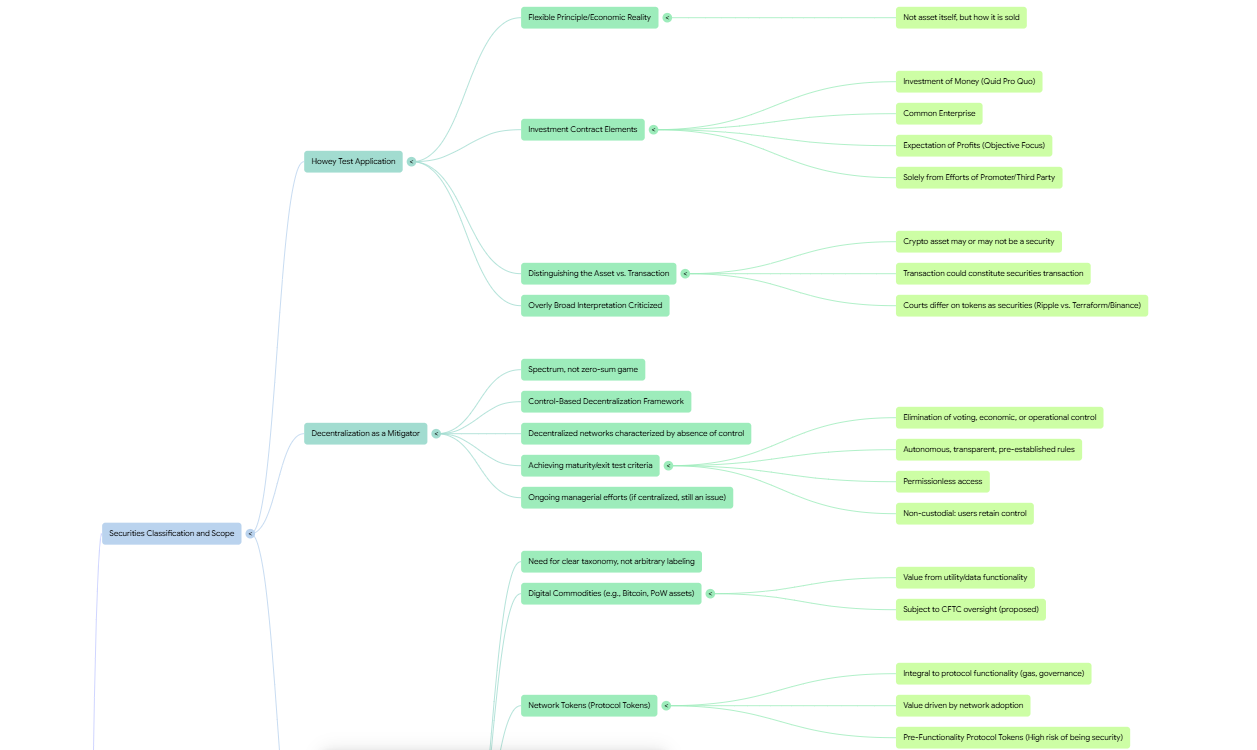
A primary legal issue is defining when tokenized RWAs constitute securities under the Howey Test, requiring a nuanced taxonomy.
Regulatory Framework Friction:
a16z crypto emphasized that decentralized safe harbors are inappropriate for RWA tokens, as the value of RWA tokens remains inherently tied to centralized, human managerial efforts.
The existing patchwork of state “blue sky” laws creates regulatory friction, severely limiting the secondary trading liquidity of tokenized private placements.
Transfer Agent Rules and Efficiency:
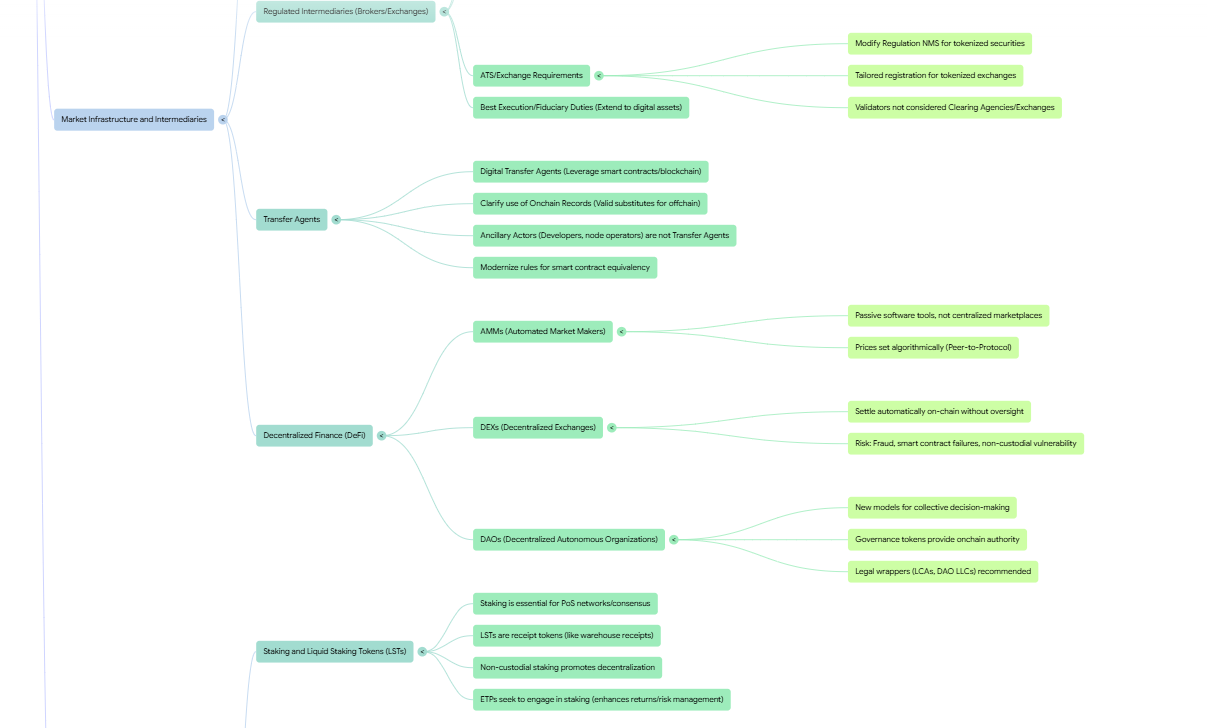
Etherealize and Etherfuse identified significant uncertainty regarding whether a crypto network can legally serve as the official, authoritative ledger of ownership for tokenized securities under current Transfer Agent rules.
SIFMA requested that legacy rules, which require maintaining redundant off-chain records, be modernized to acknowledge that DLT records can be an acceptable alternative.
Technology and Compliance Integration:
Robinhood noted that programmable compliance via smart contracts (automating AML/KYC, transfer restrictions, and corporate actions) would enhance operational integrity and reduce administrative costs.
Daniel Bruno Corvelo Costa proposed that tokenization frameworks should mandate full compliance with state property recording statutes (deeds, liens, etc.) and should integrate IoT devices to provide verifiable physical proof of the RWA’s status and performance.
Market Risk (Citadel):
Citadel Securities warned that unregulated, tokenized “look-a-like” products could siphon liquidity away from established markets and create investor confusion regarding issuer endorsement and counterparty risk.
B. Critical Monitoring and Trajectory Analysis for a New Real Estate Tokenization Company
A new real estate tokenization company must prioritize monitoring issues that directly impact liquidity and legal standing:
Blue Sky Law Resolution:
Crucial Focus: Whether Congress or the SEC establishes a federal preemption or a workable national standard for secondary trading of tokenized securities issued under Reg A/D.
Trajectory: Likely toward targeted relief or a “sandbox” approach to test solutions, as industry demand for liquidity is immense.
Transfer Agent Rule Clarification:
Crucial Focus: Finalizing guidance that recognizes the Distributed Ledger (blockchain) as the Master Securityholder File.
Trajectory: High likelihood of modernization, as SEC leadership acknowledges legacy rules are stifling tokenization innovation.
Howey Test (Efforts of Others):
Crucial Focus: Obtaining clarity on the definition of routine vs. managerial efforts (e.g., differentiating passive rent collection/maintenance from value-adding entrepreneurial activity).
Trajectory: Continued application of the Howey test, but with growing recognition that tokenization necessitates technology-neutral interpretive guidance on managerial control.
Best Case and Worst Case Scenarios for the Real Estate Tokenization Industry
Best Case Scenario:
The SEC issues clear, coordinated guidance resolving the conflicts between federal securities law and state property/resale laws. DLT is recognized as a compliant recordkeeping system, resulting in significant efficiency gains, institutional adoption, and the creation of highly liquid, transparent fractional ownership markets for real estate.
Worst Case Scenario:
Regulatory uncertainty persists, particularly regarding the unresolved burden of state “blue sky” laws and the need for redundant recordkeeping. Innovation is limited to expensive private placements, failing to achieve the promised liquidity and broad access, allowing foreign jurisdictions to assume leadership in RWA tokenization.
DOSSIER SECTION 3: ALL OTHER ISSUES (Regulatory Structure, Philosophy, and General Markets)
This section covers the shift in regulatory philosophy, governance, custody, and broader market infrastructure challenges.
A. Chronological Shift in Regulatory Philosophy (2024–2025)
Deregulatory Impulse: Donald Trump’s election initiated the most dramatic philosophical change in governmental regulation in over ninety years, emphasizing reduced regulation and enforcement.
SEC Actions: The SEC, under Chair Paul S. Atkins (2025–), established the Crypto Task Force to address regulatory uncertainty. Immediate actions included:
Dismissing “misguided litigation” and actively considering new ETPs based on non-security digital commodities.
Issuing rapid staff-level statements to “clear the brush” on issues such as meme coins and Proof-of-Work mining activities.
Dissent Against Guidance: Commissioner Caroline A. Crenshaw warned against this rapid deregulatory pace, calling it a “Reckless Game of Regulatory Jenga”.
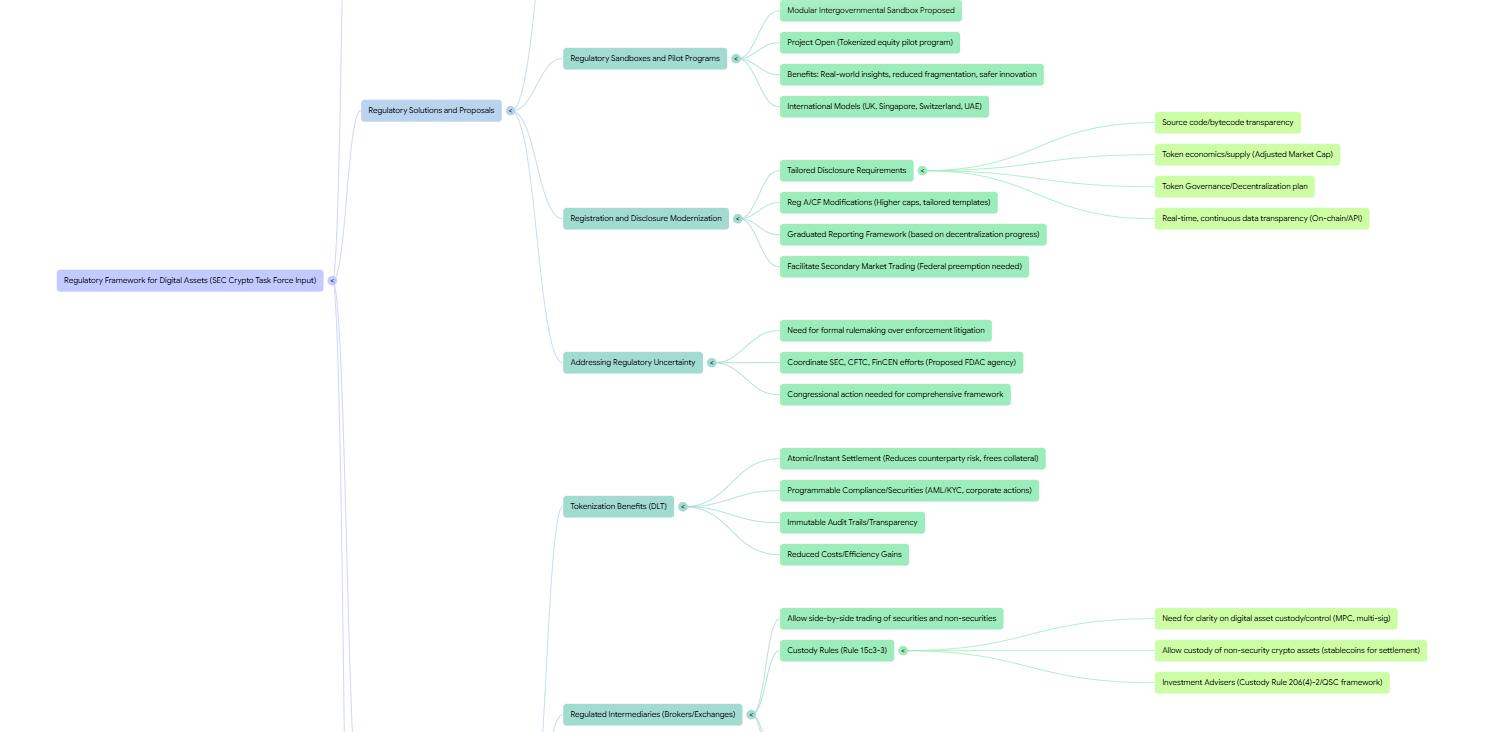
She argued that the use of staff statements and guidance, rather than formal notice-and-comment rulemaking, allows the agency to adopt extreme positions without accountability or public scrutiny.
Crenshaw stressed that this approach risks dismantling regulatory foundations established over decades and leaving retail investors vulnerable.
B. Governance, Custody, and Market Structure
Safe Harbors and Decentralization:
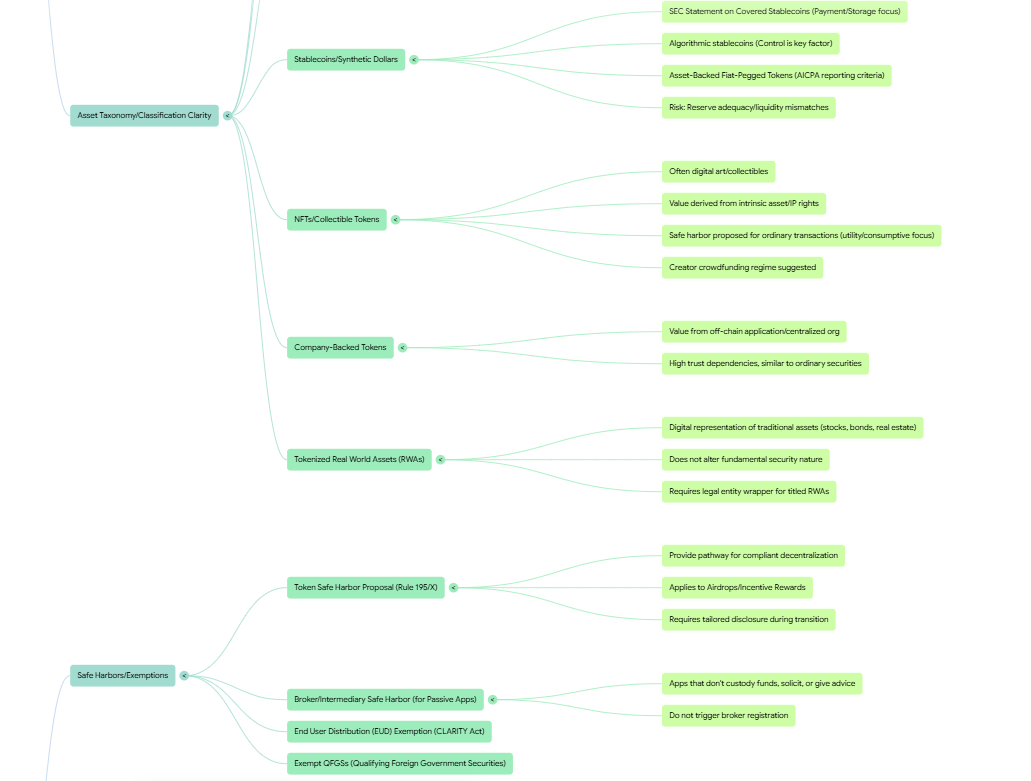
The industry, including a16z crypto, pushed for a regulatory safe harbor (like Rule 195 or Safe Harbor X) to allow early-stage projects time to achieve sufficient decentralization without immediate registration under the Securities Act.
This is intended to resolve the “chicken-or-the-egg” paradox where tokens must be broadly distributed to achieve decentralization, but broad distribution risks immediate security classification.
Intermediary Role and Consolidation:
SEC Chair Atkins supported allowing regulated registrants (like broker-dealers) to custody and trade both securities and non-securities under one roof, arguing it could reduce costs.
This vertical integration model was opposed by Nasdaq, which noted that the existing decentralized structure of traditional securities markets is not a relic but a feature designed to mitigate risk and ensure accountability.
Custody Rules (RIA Focus):
The Blockchain Association noted that the current RIA custody rule creates key challenges regarding whether the RIA or its custodian has appropriate periodic testing to reconcile crypto assets against on-chain data.
Figure Markets suggested that decentralized Multi-Party Computation (MPC) could be used to satisfy the role of a qualified custodian by allowing multiple parties to approve transactions and ensure client control.
Inter-Agency Conflict: Lewis Rinaudo Cohen highlighted that the bifurcated U.S. regulatory structure (SEC for securities, CFTC for commodities derivatives) “complicates the regulation of the digital asset sector”, resulting in a pervasive environment where entrepreneurs face constant threats of ambiguous litigation.
Securities Holding Infrastructure: Expert analysis by Charles W. Mooney, Jr. concluded that the existing intermediated securities holding infrastructure (DTCC’s monopoly) is maintained by entrenched interests (broker-dealers and banks) who lack incentives to support material modifications, arguing that reform will require top-down regulatory intervention.
C. Best Data Points Used in Comment Letters
Market Disruption (Academic): Crypto asset prices showed a swift decline (Negative CARs) of -6.5% following SEC announcements classifying assets as securities.
RWA Market Valuation: The RWA tokenization market expanded by 260% in the first half of 2025, reaching over $23 billion.
RWA Market Projection: The RWA market is projected to reach $30 trillion by 2034 (Standard Chartered).
Real Estate Projection: Real estate tokenization is projected to grow from $3.5 billion in 2024 to $19.4 billion by 2033.
Custody Disparity (Cumberland): Broker-dealers holding spot BTC take a 100% net capital haircut, compared to only a 15% haircut for the ETP shares that track that same asset.
Regulatory Friction (MiCA): The implementation of MiCA in the E.U. created such significant compliance hurdles that market entry for synthetic dollar issuers has been capital- and resource-intensive.
Compliance Cost: Annual compliance costs for crypto asset ETPs average between two million and five million dollars annually per product, largely driven by manual processes and regulatory uncertainty.